What I Found
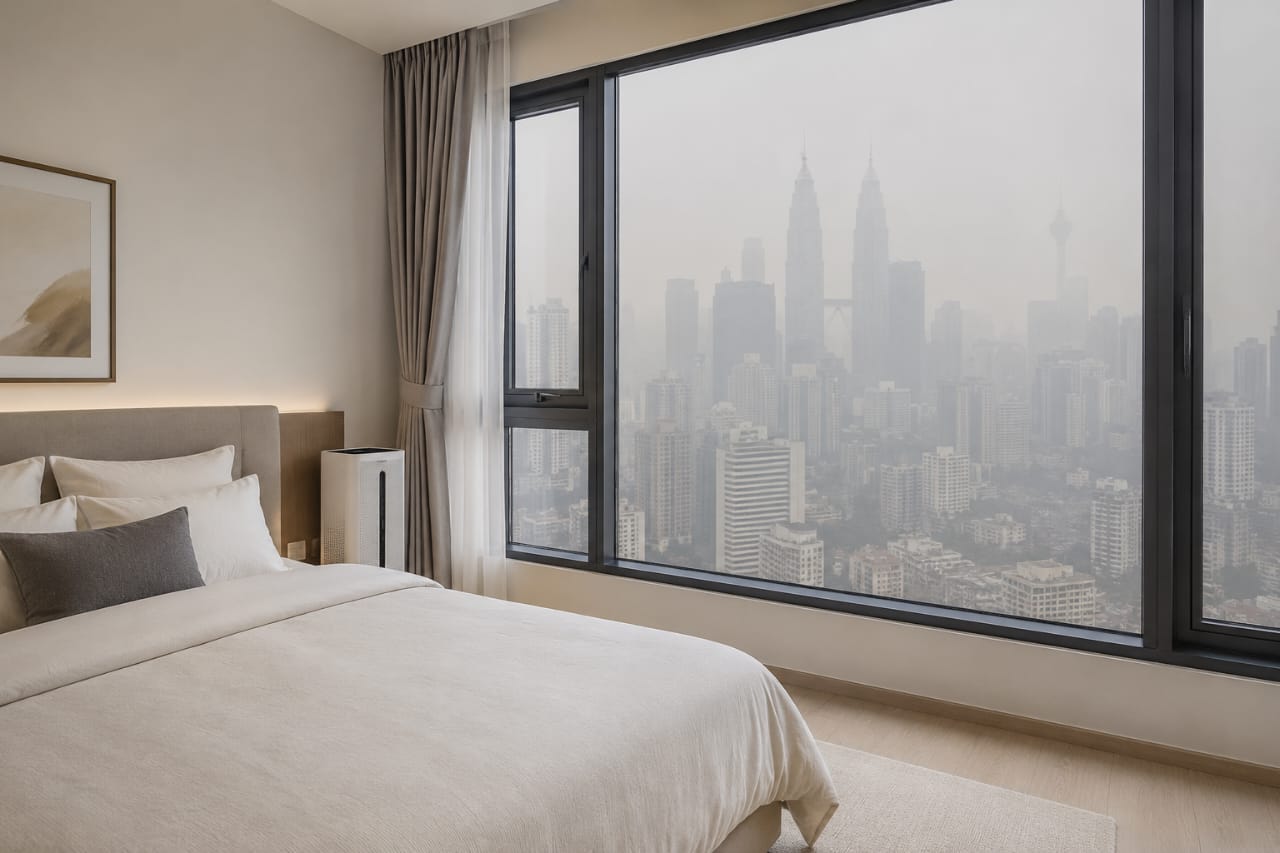
During the haze, the particle readings inside my bedroom were much higher than I expected.
Air-conditioning does not necessarily remove fine airborne particles, which made me pay much more attention to indoor air quality and air filtration.
Key Takeaways
- Haze and cooking can significantly increase airborne particle levels indoors.
- Air-conditioners mainly cool and recirculate air; they are not the same as HEPA air purifiers.
- Indoor air quality can sometimes be worse than expected, even when a room looks clean.
- Regular air-conditioner cleaning and proper air filtration may help improve indoor air quality.
- Testing particle levels can give you a better idea of what may be circulating in your home or office.
Many happenings in the past few weeks.
First, I went to visit one of my new clients who has been unwell, in and out of hospital almost every month since March this year. He suffered a stroke sometime in early March 2026, and that has left him almost bedridden for now. If you have seen people with a tracheostomy, you will understand some of the issues he is having — unable to cough out phlegm effectively, unable to swallow solid food, etc.
One of my friends has an air-tracking device that roughly tells us — actually, not roughly, quite accurately — the particle levels in the air around us. I borrowed it from him and brought it along the next time I visited my client because I wanted to understand more about his room’s air quality.
In a post-stroke patient with swallowing difficulties, aspiration is an important risk for pneumonia. Poor indoor air quality may also aggravate respiratory health, so I was curious to see what the air in his room was like.
The device showed a particle count of around *120,000 at the 0.3 micron (μm) channel*.
That caught my attention. I raised the concern with his family members and advised them to discuss with his doctor whether the room’s air quality could have any relevance to his respiratory condition.
Cut the long story short, that was *before the haze hit Malaysia some 2–3 weeks back*.
(28 August, time of writing.)
Just two nights back, I simply bought a unit of *Amway Atmosphere Mini* after hearing an Australian doctor discussing the air we breathe when sleeping in an air-conditioned room for hours every night.
An air-conditioner mainly recirculates indoor air through a relatively basic filter while cooling and dehumidifying it. Those filters can catch larger dust particles, but they are generally *not equivalent to a HEPA air purifier when it comes to filtering fine airborne particles*.
So whatever is already present in the room — fine dust, pollen and other airborne particles — may continue circulating. And then there is mould and other contamination that may develop if an air-conditioning system isn’t properly cleaned and maintained.
*Do you service your aircon periodically… or only when it breaks down? 😅*
Can you now imagine what we could be inhaling throughout the night?
Happily, I unboxed my Atmosphere Mini when I got home and immediately tested my bedroom air.
To my surprise…
*400,000!!!!!!!*
I couldn’t believe it.
I tested it a couple of times and the reading didn’t differ much.
Then I remembered something.
I’m always preparing *mala hotpot* in the kitchen and the whole house gets filled with that aroma.
Could that be the cause?
Took out my handphone and Googled whether cooking mala/hotpot could spike particle readings on an air monitor.
*Yes, cooking can generate very high levels of airborne particles.*
What a relief. 😂
Or so I thought.
The next morning, I woke up and checked the reading again.
*Still floating around 300k!!!*
No. No way.
This device must be malfunctioning, I thought.
Then another thought came to me.
Why not test the air *outside*?
Okay…
I extended my arm out of my condo window with the monitor.
*400k.*
Ahhhhh.
Now I had another possible explanation.
*The haze.*
I remembered testing my bedroom some time back and seeing readings of only around *10,000++ on the same device*, so the difference certainly got my attention.
And that’s when I became very glad that I had brought home the *Amway Atmosphere Mini* just in time for the haze.
Why the Mini instead of the bigger Atmosphere Sky?
Simple.
I’ll probably be getting another Mini for the room next door. 😂
According to Amway Malaysia, *Atmosphere Sky is rated for rooms up to 465 sq ft (43 m²), while the **Atmosphere Mini is intended for smaller rooms up to 200 sq ft (18.6 m²).*
Perfect for my *peanut-sized bedroom*.
I’ll end this article a little short because I want to get it out while the haze is still very much on everyone’s mind.
I’ll also attach some graphics showing why, after looking at the filtration performance, certifications and testing behind these units, *Atmosphere Sky/Mini is my preferred choice.*
If you’re interested, I can bring the air monitor along and *test the particle levels in your home or office*.
And if you’d like, we can test out the Atmosphere as well.
Frequently Asked Questions
1. Does haze really get inside the house even when the windows are closed?
Unfortunately, yes. Fine particles can still enter through small gaps, doors, windows and ventilation. And if you are using air-conditioning, the same indoor air is mostly being recirculated again and again.
2. Isn’t air-conditioning enough to clean the air?
Not really. Aircon filters are mainly there to catch larger dust and help the system run properly. They are not the same as a proper HEPA air purifier when it comes to filtering very fine airborne particles.
3. Can cooking really make the particle reading shoot up so high?
Oh yes. I learnt this the funny way after thinking my air monitor had gone crazy. 😂 Cooking — especially frying, grilling or something as powerful as mala hotpot — can push particle readings up very quickly.
4. How do I know whether the air in my room is actually clean?
The easiest way is to measure it. Our eyes and nose are not always very good at telling us what is floating in the air. An air monitor can at least give you a better idea of the particle levels around you.
5. Do I need an air purifier in every room?
That depends on the room size, how you use the space and the air quality in your home. Personally, I prefer using a smaller unit for a smaller bedroom rather than trying to cover the whole house with one machine.
6. Can you help me test the air quality in my home or office?
Sure. If you’re curious, I can bring the air monitor along and check the particle levels with you. At least then we are looking at an actual reading instead of just guessing. 😊